| Microphone recording |
Shown in demo |
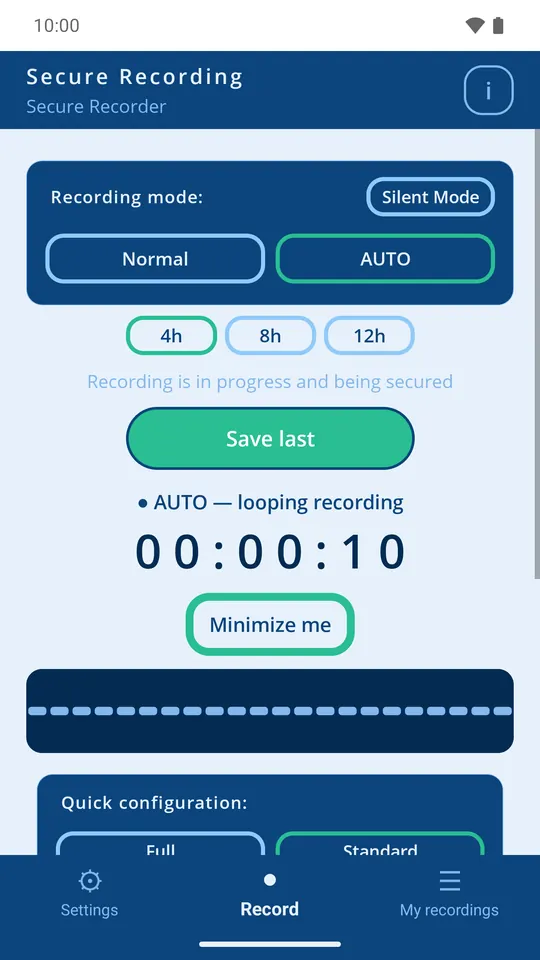
Start, pause, resume and stop with one tap. Recording continues in the background with an ongoing notification that has pause and stop controls. |
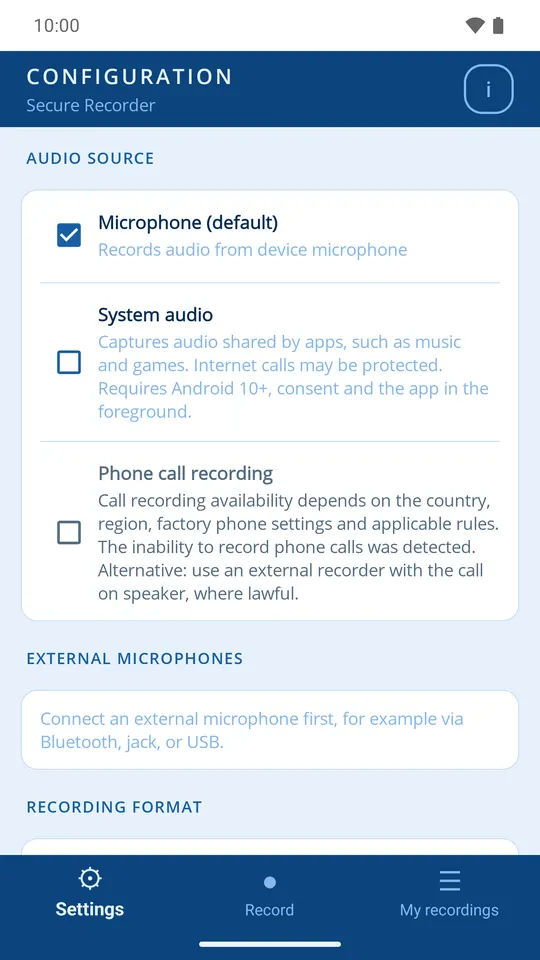
Microphone permission; notification permission recommended on Android 13+. Some manufacturers stop background apps aggressively; battery-optimisation exceptions may be needed. |
| AAC, Opus and WAV |
Shown in demo |
AAC (.m4a, default 128 kbps), Opus (.ogg) or uncompressed WAV. When free storage drops below about 100 MB the app can switch to Opus automatically. |
Opus recording requires Android 10 or newer. |
| AUTO mode (rolling buffer) |
Shown in demo |
Records continuously and keeps only the last 4, 8 or 12 hours. “Save last” joins the buffered segments into one file per audio source. |
Enough free storage for the chosen window. Older segments are discarded automatically; when storage runs low the oldest audio is removed first. |
| Hands-free triggers |
In the app, not shown in demo |
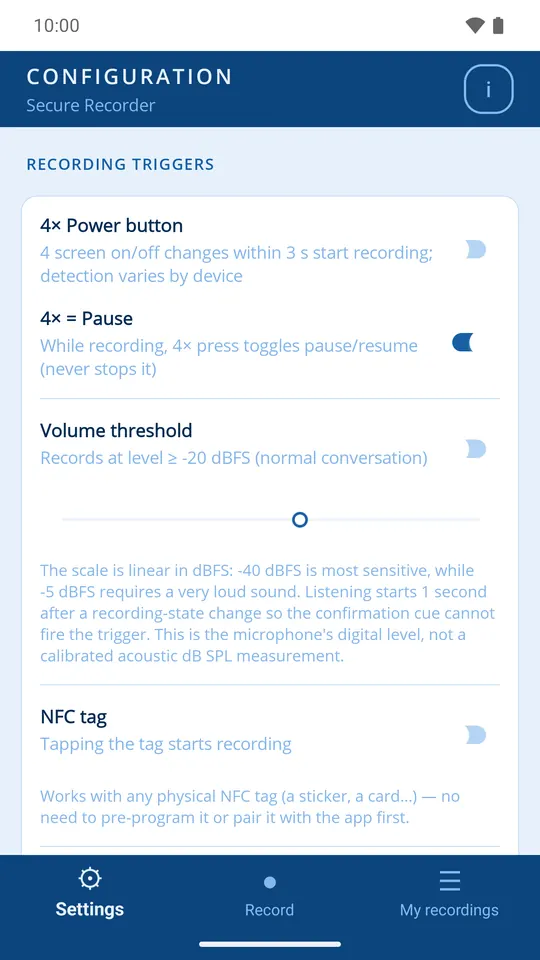
Start recording with a spoken phrase (recognised on the device), a sound-level threshold, an NFC tag or four presses of the power button. Spoken phrases can also pause or stop. |
NFC hardware for NFC triggers; a downloaded offline speech model for phrases. Behaviour depends on the device, the lock screen and Android background restrictions. |
| System audio capture |
In the app, not shown in demo |
Records audio played by other apps, after you confirm Android's screen-capture dialog. |
Android 10 or newer; confirmation for every session. Apps can block capture of their audio; protected content and many call apps are not captured. |
| External microphones (USB, jack, Bluetooth) |
In the app, not shown in demo |
Connected inputs reported by Android are listed per device. A USB or wired microphone can replace the built-in microphone (“Alternative”) or record an extra, separate file in the same session (“Additional”). Bluetooth headsets can only be “Additional”. |
A microphone that Android recognises as an audio input (USB audio class, wired headset or Bluetooth headset). Not yet verified with real USB hardware for this page. Simultaneous capture from several inputs depends on the phone's audio hardware and is not guaranteed. Bluetooth uses the narrow-band call link (16 kHz). |
| Library: tags, filters, sorting |
Shown in demo |
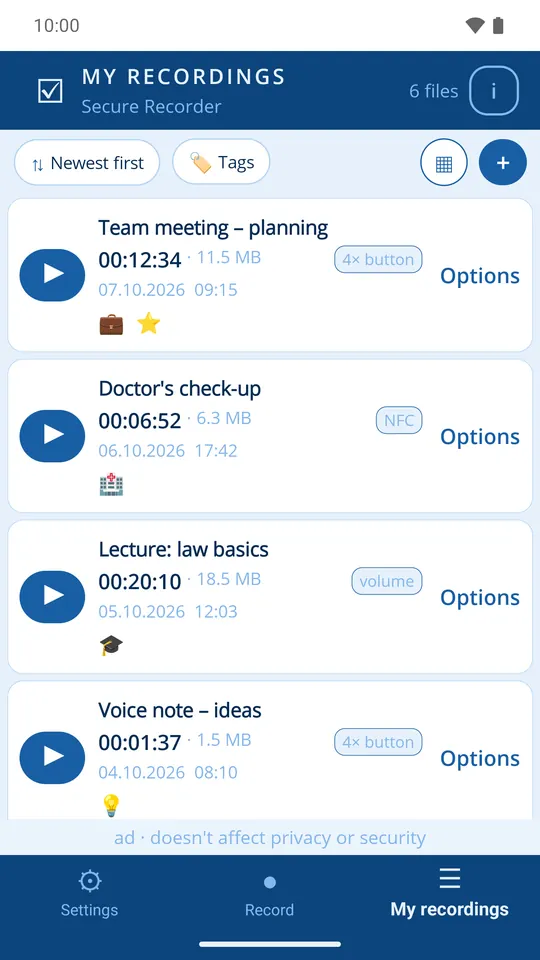
Twelve built-in tags (e.g. Work, Important, Education), filtering by up to five tags, six sort orders, list or grid view, and import of existing audio files from the phone. |
No free-text search and no folders; you cannot create your own tags. |
| Player, waveform and trimming |
Shown in demo |
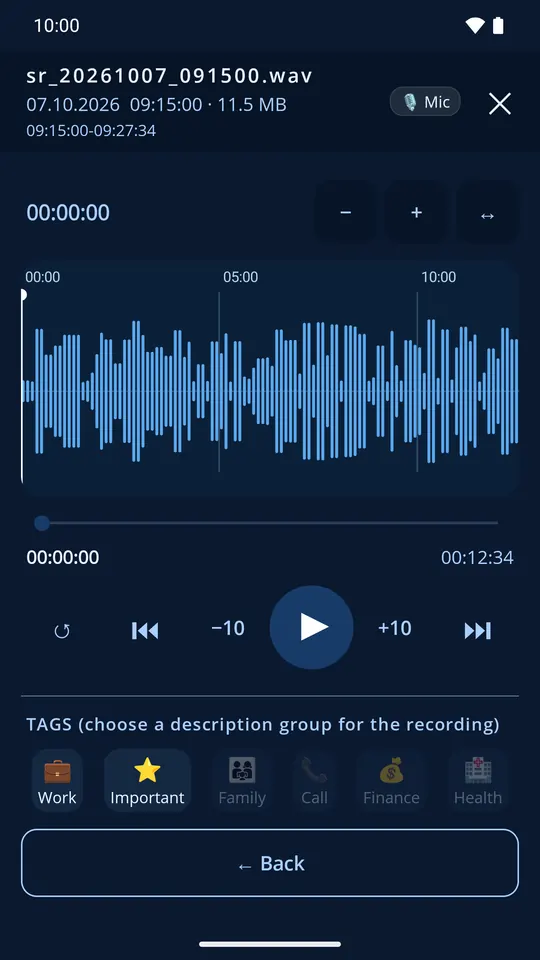
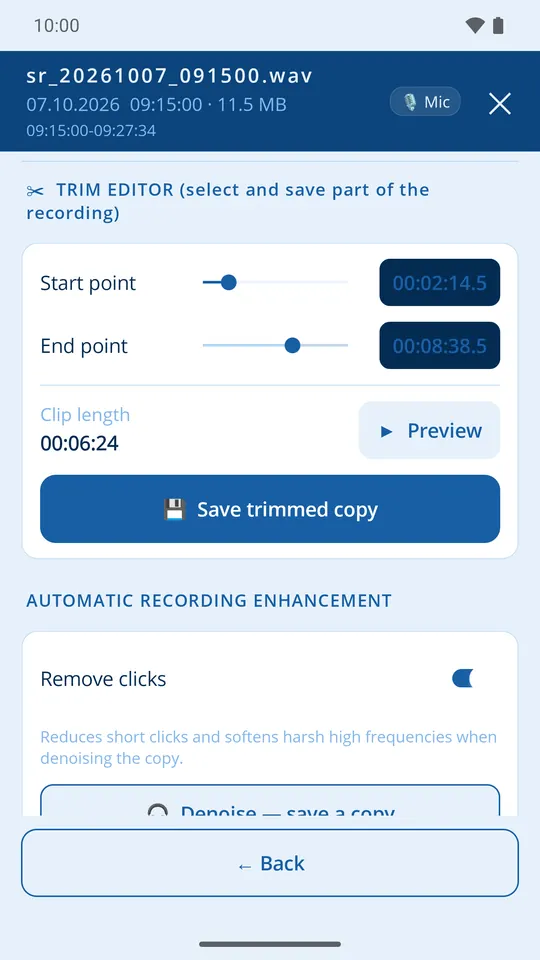
Zoomable waveform, 10-second skips and a trim editor. Trimming saves a new copy in the library; the original stays unchanged. |
|
| Denoised copy |
In the app, not shown in demo |
Creates a noise-reduced copy in the background from the player. The original recording is kept as captured. |
|
| On-device transcription |
In the app, not shown in demo |
Whisper (Small, Medium, Large-v3 Turbo) turns a recording or a selected fragment into text on the phone; the audio is not sent to a transcription server. |
The model must be downloaded first (internet required for the download). Speed and accuracy depend on the phone, the model and the recording quality. |
| Share and export |
Shown in demo |
Select one or many recordings and share them through any Android app, save them to Downloads, or queue them for your cloud. Export keeps the original format or converts to WAV. |
Shared and exported copies are outside the app's control and are not encrypted by it. |
| Upload to your own cloud |
In the app, not shown in demo |
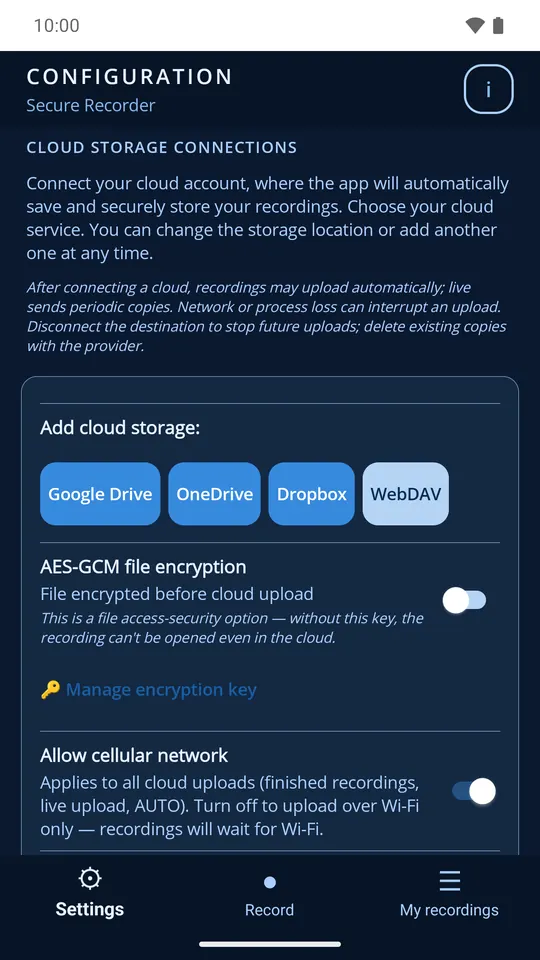
Google Drive, OneDrive, Dropbox or a WebDAV server (HTTPS only). Finished recordings are uploaded automatically with up to three retries. Uploads over mobile data can be switched off. |
Your own account with the provider and an internet connection. The upload queue lives in the running app; an interrupted upload may need to be started again. Disconnecting an account removes the sign-in from the phone, not your cloud files. |
| Live copies while recording |
In the app, not shown in demo |
Optional (off by default): while you record, playable blocks are sent to your cloud periodically, so part of a recording survives if the phone is lost mid-session. |
A connected cloud destination and a working connection during recording. Periodic copies, not a continuous stream: audio recorded after the last successful block is lost with the phone. |
| AES-256-GCM encryption before upload |
In the app, not shown in demo |
Optional (off by default): final files and live/AUTO copies are encrypted on the phone before they reach the cloud. You can export and import the key. |
Local recordings, temporary files, transcripts and exports are not encrypted. Without the same key the cloud copies cannot be decrypted. |
| PIN lock for the app |
Shown in demo |
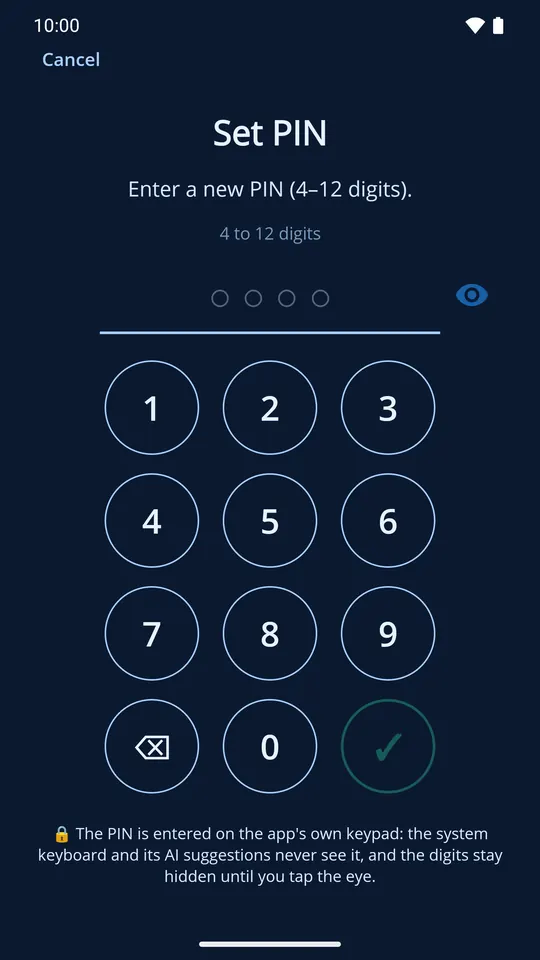
An in-app keypad PIN protects access to the interface, optionally again after the app has been minimised. |
The PIN locks the interface only; it does not encrypt files on the phone. |
| Local emergency copy |
In the app, not shown in demo |
On by default: the active recording is copied periodically to the public Recordings/SecureRecorder folder so it can be recovered after a crash. |
The copy is unencrypted and readable by other apps with storage access; it does not protect against loss of the phone. |
| Phone call recording |
Not available |
Not offered as a general feature. Android restricts call audio for third-party apps; the app points to the phone's built-in call recorder where one exists. |
|
| Manual merging or mixing of recordings |
Not available |
Separate recordings cannot be joined or mixed by hand. Parallel inputs are saved as separate files; only AUTO “Save last” joins its own buffer segments. |
|

 Secure Recorder